
Historians have debated whether it is better to use modern phrases or historic language to describe people and their circumstances. By choosing more descriptive, thoughtful, and humanizing language to tell stories, historians can help to restore personhood and agency to those who were denied it. For example, by replacing words like “Master” with “enslaver,” “run-away” with “self-emancipated,” and “slave” with “enslaved person,” we are reminded that enslaved people had complex identities. Enslavement is a condition that was imposed on them, not the sum of who they were.
African American History Initiative
In the Puddle Dock neighborhood, people from Africa and the Caribbean were enslaved by several prominent families. Learn more about the historic households at Strawbery Banke where enslaved Africans lived and worked below.
Enslaved Peoples


In the Puddle Dock neighborhood, people from Africa and the Caribbean were enslaved by several prominent families. Learn more about the historic households at Strawbery Banke where enslaved Africans lived and worked below.
-
Two enslaved Africans lived and worked at the Sherburne House. Joseph Sherburne’s 1744 estate inventory listed one Negro man valued at 200 pounds and one Negro woman valued at 50 pounds. Material evidence of their origins on the African continent includes a cowrie shell recovered during archaeological excavations in 2019 (seen above, left).
-
Frank and Flora lived and worked at the King's Arms Tavern (c. 1766). They were enslaved by tavern keeper James Stoodley. Frank and Flora were also mentioned in the records of pews Stoodley owned at North Church. Stoodley's estate inventory at the time of his death in 1779 included Frank and Flora, valued at 20 and 100 pounds, respectively.
-
James lived and worked at the William Pitt Tavern (c. 1766). He was enslaved by tavern keeper John Stavers. Fortune, who was enslaved at the Stavers’ previous tavern, emancipated himself as a “run-away” when he was 16 years old, which was recorded in an advertisement in The New Hampshire Gazette on May 11, 1764 (seen below).
-
Nero, Jane, and Cato were enslaved by Cooper Jeremiah Wheelwright (d. 1768). Nero was a cooper himself, acquired by Wheelwright through marriage. Wheelwright purchased Cato prior to 1752 for 200 pounds, a price equal to some houses at the time. Nero and Jane were listed in Wheelwright's estate inventory, valued at 30 and 20 pounds, respectively.
-
Adam, Mercer, and Bess lived and worked at the Marshall Pottery (c. 1736-1749). They were enslaved by Samuel Marshall. Adam and Mercer likely worked alongside Marshall, making and shipping redware pottery for sale locally and along the Atlantic coast. A redware jar manufactured in the West Indies was recovered by archaeologists from the Marshall Pottery site in the 1970s, linking the household to the Caribbean (see above, right).

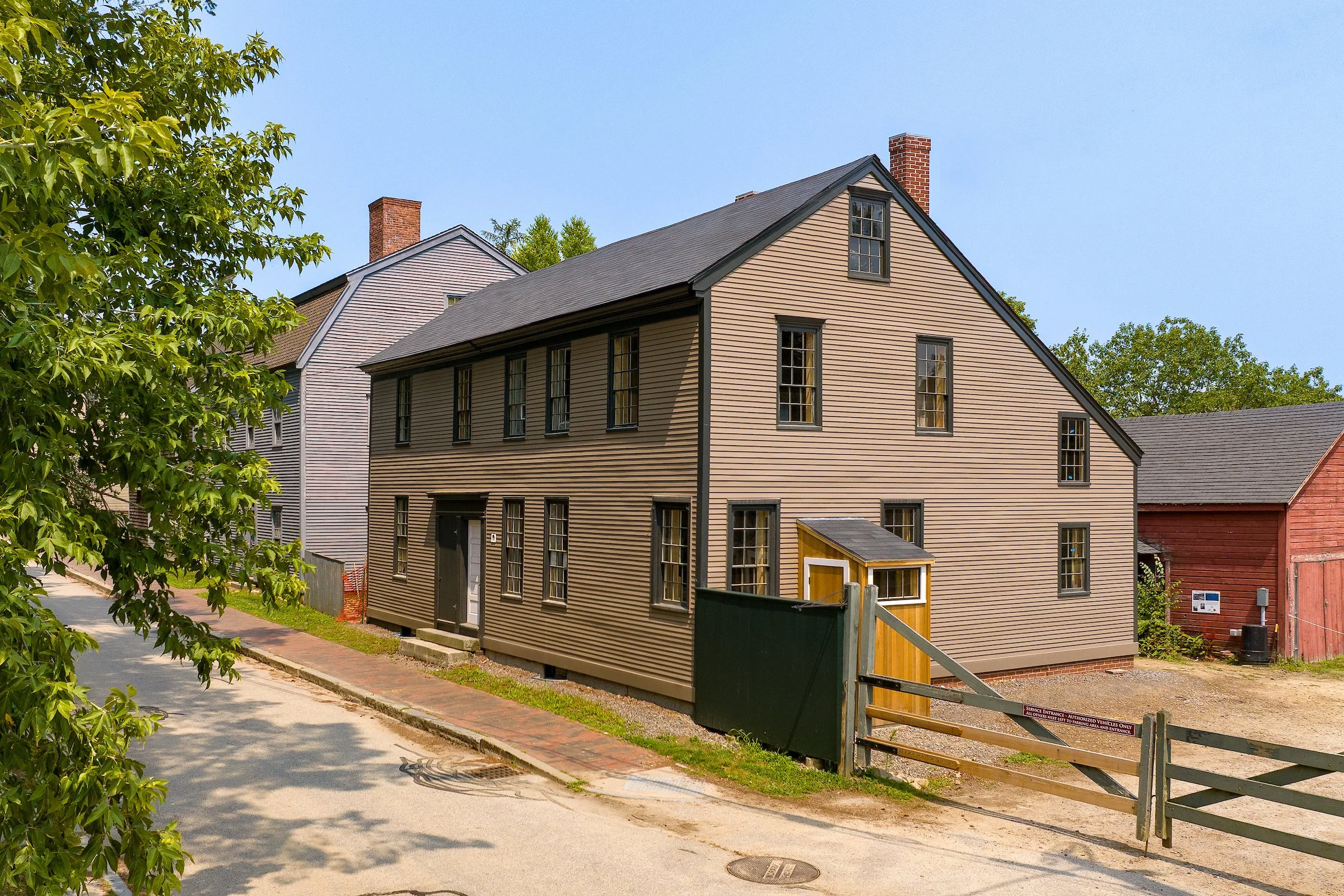
From 1937 to 1943, Kenneth, Eleanor, and Geraldine (Jeri) Cousins lived in this house, former residence of 18th-century Judge Samuel Penhallow. The Cousins’ story is one of the Great Migration and how a Black family made their way in Portsmouth. When last occupied, Penhallow-Cousins House contained three apartments formerly occupied by African-American families. Strawbery Banke intends to interpret the 20th-century Black experience in Penhallow-Cousins House.
The Black Heritage Trail of New Hampshire also includes sites and stories in the Puddle Dock neighborhood. Click here to learn more about Black Heritage Trail sites on the museum grounds.